
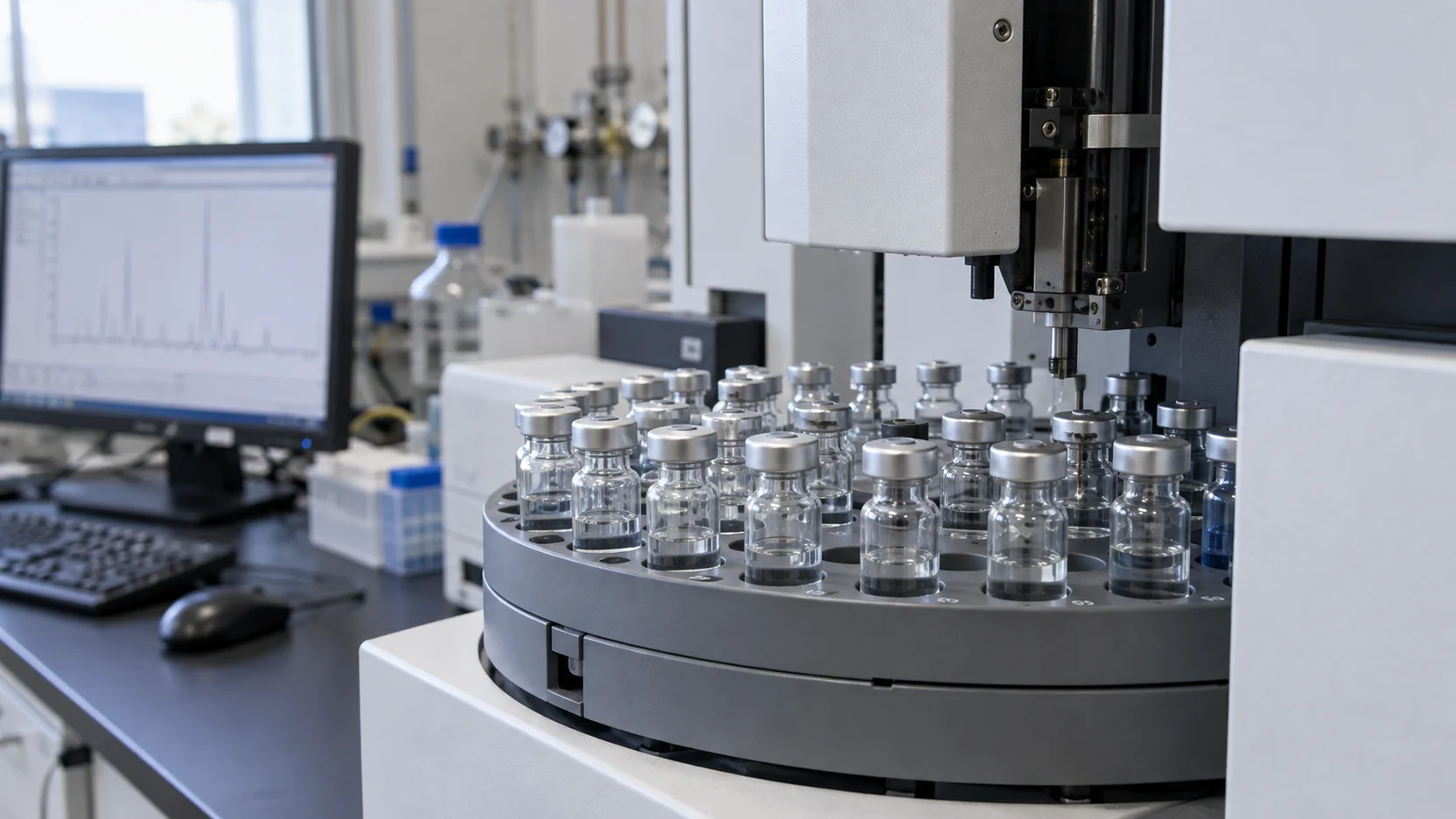
Purity figures of 99.9% and 99.99% need to be understood in relation to the test method and calculation basis. On a mass-fraction basis, they describe the main component’s share of the total mass; values calculated from gas chromatographic peak areas mean something different. Water and specific impurities also require their own test results.
Mass fraction and chromatographic area percentage are different
Mass fraction is the mass of the main substance divided by total sample mass. If the result genuinely accounts for all components by mass, the remainders at 99.9% and 99.99% are 0.1% and 0.01%, equivalent to 1000 ppm and 100 ppm. If the statement is ≥99.9%, the remainder is an upper bound, not the measured total impurity content of that batch.
Gas chromatography (GC) represents components that the method can separate and detect as individual chromatographic peaks. Area percentage is the main peak’s area divided by the total peak area included in the calculation. Different substances may have different detector responses, and water, inorganic salts or nonvolatile substances may not be included. Consequently, 100% minus GC purity cannot be treated directly as the mass content of all impurities.
Why samples with the same purity may still differ
Even when two samples have the same main-component mass fraction, the remainder may contain different substances. Small amounts of water, alcohols or metals may affect a particular formulation differently from the same mass of another carbonate. Purity describes how much of the main component is present; impurity analysis further establishes what the remainder contains.
Battery-solvent documentation therefore often lists main-component content, water, acidity and specific impurities separately. Water content describes the amount of water; acidity reflects acidic components under the relevant method. Metals, particles and nonvolatile residues each require testing suited to their targets. No single purity test automatically covers all this information.
The analytical method determines what can be seen
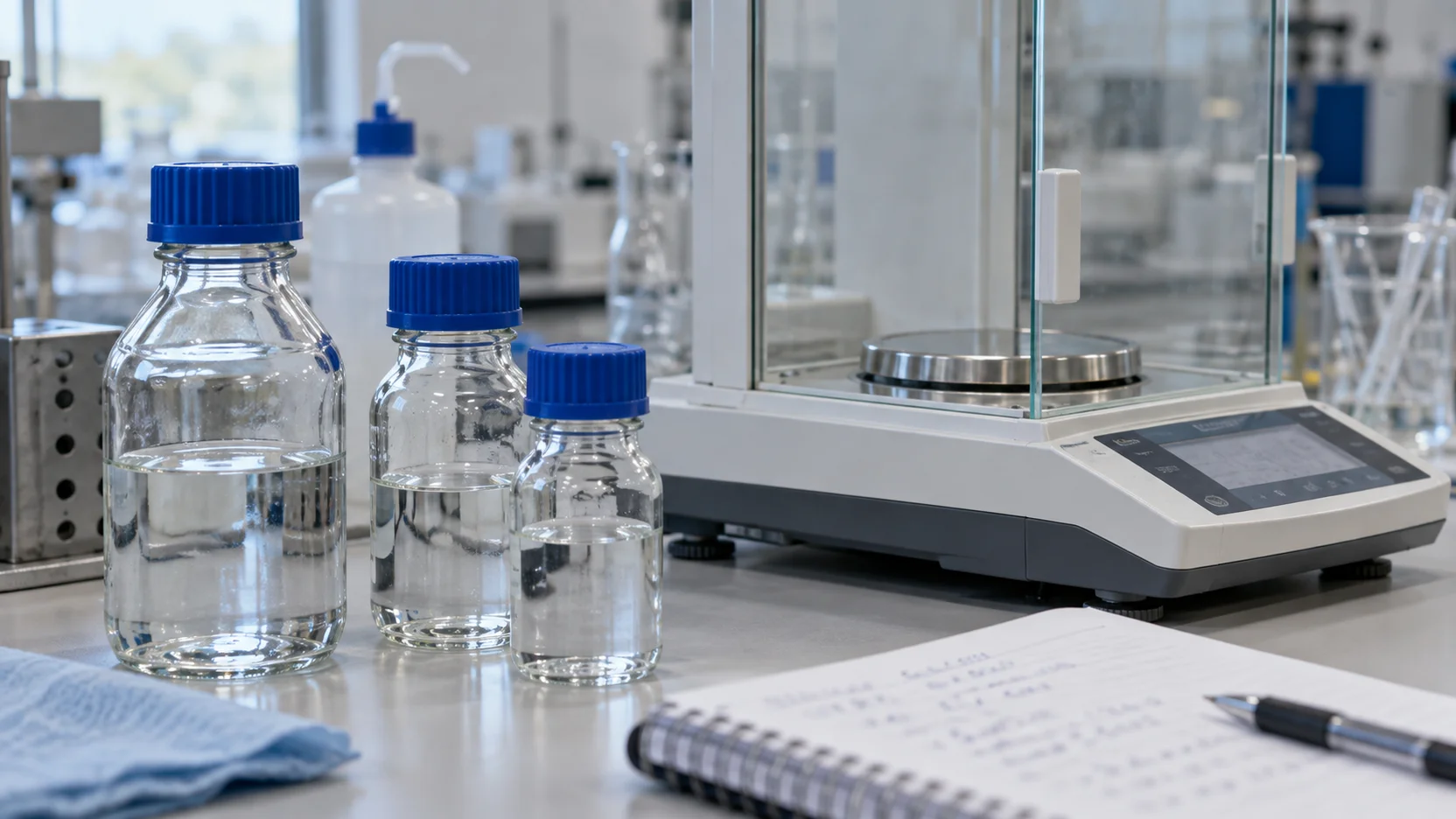
Peak separation, detector sensitivity to the target and calibration for quantification all affect the result. Tests with identical names but different methods may not yield directly comparable values. Method information helps explain which substances a result covers and its precision.
Not detected on a report generally means below the method’s detection capability, not absolute absence. Below the quantification limit means the content is too low for reliable quantification by that method. Reporting more decimal places does not automatically improve measurement accuracy.
Analytical example: Agilent uses gas chromatography with mass spectrometric detection (GC/MSD) and external-standard calibration to analyze carbonate solvents and additives in electrolyte samples. The target components include DMC, EMC, DEC, EC and PC. This example concerns organic-component analysis; water, trace metals and other parameters require methods suited to their respective targets.
Read specifications, typical values and batch results separately
A minimum purity in a specification is a product requirement. A typical value in a technical data sheet describes a common characteristic. A result in a batch certificate of analysis relates to a specific batch number and tested sample. Similar tables may present all three, but they are different kinds of information.
When reading purity documentation, first establish the calculation basis of the percentage, then examine the separately listed impurities and distinguish specification limits from measured batch results. Suitability for the target battery system also depends on the identities and concentrations of these impurities and on application results.
Example test report: all numbers below are hypothetical and illustrate how to read the fields. They are neither Lixing specifications nor an actual batch report.
| Parameter | Unit | Specification limit | Measured value | Method |
|---|---|---|---|---|
| Water | mg/kg | ≤20 | 12 | Applicable Karl Fischer method |
In the table, 20 is the permitted upper limit and 12 is the sample result. mg/kg expresses milligrams of water per kilogram of sample, and the method field identifies the measurement basis. This row describes water only; it cannot be subtracted from GC area purity to complete the overall composition.
References
Agilent: GC/MSD analysis of carbonate solvents and additives in battery electrolyte (5991-9356EN)
IUPAC terminology: limit of detection
Metrohm: Karl Fischer water determination and battery material analysis