
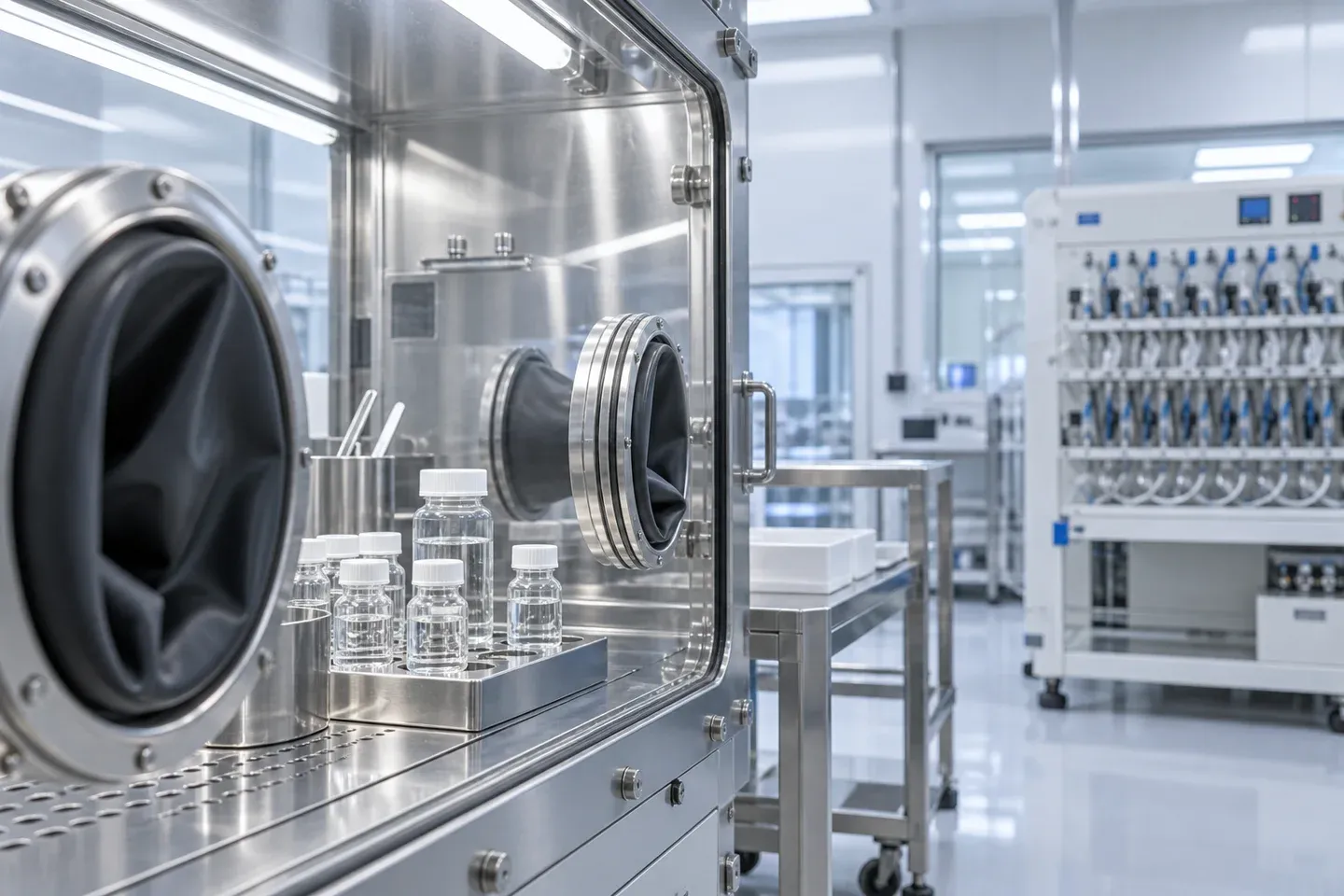
Electrolytes connect ion pathways with electrode reactions
When a lithium-ion battery operates, electrons flow through the external circuit while ions must migrate inside the cell. The electrolyte penetrates the porous electrodes and separator to form continuous ion pathways. Carbonate solvents provide a liquid environment for lithium salts and also participate in coordination around lithium ions and reactions at electrode surfaces. Solvent selection therefore requires an understanding of both how the liquid flows and how ions reach and enter the electrodes.
Salt dissolution, salt dissociation and solvation are different concepts. After a salt dissolves, its positive and negative ions may still associate with each other. Meanwhile, solvent molecules interact with lithium ions through their oxygen-containing sites, creating a continually changing local environment. A high dielectric response helps weaken electrostatic attraction between ions, but does not by itself establish how many ions effectively contribute to conduction, let alone how fast they migrate.
Porous structures also give low viscosity a concrete meaning: a more fluid liquid can enter pores more readily, but complete wetting also depends on surface properties, pore size and electrolyte-filling conditions. A clear liquid that flows freely in a bottle answers only some questions about the liquid. Whether it forms uniform pathways inside an electrode must be examined in the relevant structure and process.
Technical references: [1]
Roles and operating conditions of the five carbonates
Ethylene carbonate (EC) is a cyclic carbonate that supports both lithium salt dissociation and film formation on the negative electrode in many conventional formulations. Its phase behavior also imposes constraints: the reference melting point of the pure substance is about 36°C, which does not represent the minimum operating temperature of a mixed electrolyte. Once other solvents, salts and additives are introduced, the phase equilibrium of the whole system must be reconsidered.
Dimethyl carbonate (DMC) is a linear carbonate with a methyl group at each end, often used as a cosolvent to adjust fluidity. Mitsui’s general physical property table lists a pure-substance melting point of 4.65°C, a reminder that low viscosity and resistance to crystallization at low temperatures are separate properties. Increasing DMC also changes evaporative losses and the solvation environment; it is not a control that changes viscosity alone.
Ethyl methyl carbonate (EMC) has a methyl group at one end and an ethyl group at the other, with a reference melting point of ≤−53°C. Its low freezing temperature in the pure state makes it a candidate component for extending the liquid-phase range at low temperatures. In a formulation, this range also depends on the EC proportion, salt concentration and other components.
Diethyl carbonate (DEC) has an ethyl group at each end; Mitsui’s table lists a pure-substance melting point of −43°C. DEC, DMC and EMC are not interchangeable fillers whose differences can be ignored: changing the component alters liquid-phase interactions and vapor–liquid partitioning. A meaningful conductivity comparison requires the same salt, concentration, temperature and basis for the mixing ratio. Melting or boiling points of the pure substances alone cannot establish a performance ranking.
Propylene carbonate (PC) is a methyl-substituted cyclic carbonate that can serve as a polar solvent in electrolytes. Its relatively wide liquid-temperature range and ability to dissolve salts are useful in applications. For graphite negative electrodes, however, forming a suitable interface is a separate requirement. PC is neither prohibited in every graphite system nor equivalent to EC in a substitution that leaves all other conditions unchanged.
Starting points for comparing the five raw materials
Melting points are Mitsui’s general properties for pure substances. For EC, about 36°C is TCI’s reference property and 37–39°C is the specification range for that reagent. These are neither Lixing delivery specifications nor operating temperatures for mixed electrolytes. ≤−53°C denotes an upper limit. The roles highlighted are emphases, not exclusive functions. Lixing’s EMC product data lists a melting point of −14.5°C. The ≤−53°C value above is a third-party reference for the pure substance; these values are not interchangeable acceptance criteria. Use the applicable product documents and agreed conditions for purchasing and handling.
Why carbonate mixtures are common
Blending seeks a workable combination of phase behavior, flow, salt dissociation and interfaces, rather than assigning each material an unrelated task. EC often contributes strongly to salt dissolution and film formation, while linear components often help adjust flow. This emphasis does not mean that EC alone provides coordination and the other components merely dilute it.
The original 2017 study by Lee and colleagues observed interactions and exchange between DEC and lithium ions and discussed evidence of DMC participation in solvation in PC/DMC mixtures. The important implication for formulations is that linear carbonates can also enter the local structure around lithium ions and that solvent molecules exchange. Replacing a cosolvent may therefore change both ion movement and the removal of coordinating molecules after ions reach an electrode, rather than simply changing macroscopic viscosity.
Conductivity reflects the collective ability of ions in a salt-containing liquid to carry current; it does not measure lithium-ion transport alone. Raising salt concentration supplies more ions but may also strengthen association and increase viscosity. These competing effects mean that conductivity need not rise continuously as more salt is added. Treating an identical numerical mass ratio and volume ratio as the same formulation likewise obscures real differences in composition.
Technical references: [1]
SEI formation and the conditions for PC–graphite compatibility
When the negative electrode is at a potential where the electrolyte can be reduced, some components react first and form a solid electrolyte interphase (SEI). The desired interface allows lithium ions to pass while suppressing continuing electron-driven electrolyte decomposition. Repeated disruption or continued growth of the film consumes active material and increases transport resistance. Film formation is therefore not the same as formation of a stable, functional film.
EC can participate in this process, but the composition and integrity of the film also depend on the salt, additives, electrode surface and formation conditions. In some conventional graphite systems, PC accompanies solvated lithium during co-intercalation, causing unfavorable changes between the graphite layers. Remaining liquid and dissolving salts do not offset this interfacial risk.
Pan, Wang and Lucht studied LiTFSI/PC with binder-free graphite in 2016. The study reports continuous reduction at low salt concentrations and reversible lithium intercalation and deintercalation at higher concentrations. Improved performance was associated with increased LiF content in the SEI. This supports the conclusion that concentration and interfaces can change the outcome; it does not establish LiF as the sole determinant of performance, and these electrode results cannot be converted into a full-cell lifetime.
Jeong and colleagues also investigated the effects of film-forming additives on graphite surfaces in PC solutions. A 2001 study of carbon-coated graphite reported suppressed co-intercalation and reduced initial irreversible capacity in the PC-based electrolyte studied. These investigations changed additives or surface conditions separately; they cannot be combined into a universally validated formulation.
Why cell power can fall even when the liquid does not crystallize
After a cell cools, it may be unable to maintain its previous output even if its electrolyte still flows. First, the absence of crystallization only means that no phase-change blockage has been observed; viscosity may still increase and ion transport may still slow. Second, after reaching an electrode, lithium ions must undergo desolvation, cross the interface and diffuse within the electrode. These processes are also temperature-dependent.
To distinguish these levels, tests on the salt-containing liquid can be considered alongside cell tests at the same temperature. A fall in liquid conductivity points toward bulk transport. If conductivity changes little, the interface, electrode structure, state of charge and test rate still need consideration. A single decline in output cannot be attributed uniquely to one solvent, nor can switching to a raw material with a lower freezing point alone establish that the problem is solved.
What raw material purity, water and impurities each tell us
The purity of the main component describes its proportion but does not fully characterize the remainder. GC separates organic components within its applicable scope, and GC area percentage is not automatically a mass fraction. Karl Fischer analysis addresses water; acidity represents acidic components under a specified method; metals and particles require their own analyses. Agilent’s GC/MS application document covers carbonates and additives in electrolytes, rather than providing a universal testing scheme for water and all metals.
In LiPF6-containing systems, water can participate in reactions that generate acidic species, so water content needs to be specified separately. Metals must be considered in terms of element identity, concentration and chemical form: detecting an element does not prove that it causes substantial performance loss. Different electrodes and objectives may have different sensitivities to the same impurity. Limits must serve the application and be accompanied by comparable sampling and measurement conditions.
Raw materials and further reading
Lixing supplies DMC, EMC, DEC, EC and PC raw materials. For an established target system, product names and necessary quality requirements can be compared with available specifications. Further explanations of purity data, water mass balances and PC–graphite compatibility are available in our resource center. Information on individual raw materials, mixed electrolytes and cell results answers different questions.
Raw material enquiries
- Cell application and solvents of interest
- Existing specifications or critical water and impurity requirements, if any
- Trial quantity or expected consumption, if established
Common questions
Does the same stated value of 1 mol/L represent the same concentration basis before and after cooling?
mol/L is defined by solution volume, which changes with temperature. Comparisons therefore need to state both preparation and measurement temperatures. mol/kg is defined by mass, but the denominator must also be identified as solvent or another agreed basis.
How can a change in mixing ratio be distinguished from a change in impurities after replacing a raw material?
The main-component content determines the amount actually introduced; water and other impurities are accounted for separately. Formulation quantities, salt and test conditions must be comparable before the origin of a change can be assessed.
Technical references
- [1] Lee et al., 2017, Ultrafast fluxional exchange dynamics in electrolyte solvation sheath of lithium ion battery
- [2] Mitsui Fine Chemicals: general physical property table for carbonate products
- [3] TCI, Ethylene Carbonate E0076
- [4] Pan et al. (2016): LiTFSI/PC and binder-free graphite (abstract held by the authors’ institution)
- [5] Original study of film-forming additives on graphite surfaces in PC systems
- [6] 2001, Characteristics of carbon-coated graphite prepared from mixture of graphite and polyvinylchloride as anode materials for lithium ion batteries
- [7] Metrohm: battery material analysis documentation
- [8] Agilent: Determination of Carbonate Solvents and Additives in Lithium Battery Electrolyte Using the Agilent 5977B GC/MSD
These sources provide further explanations of application principles. Delivery requirements for Lixing raw materials are defined by the product specification agreed by both parties.