
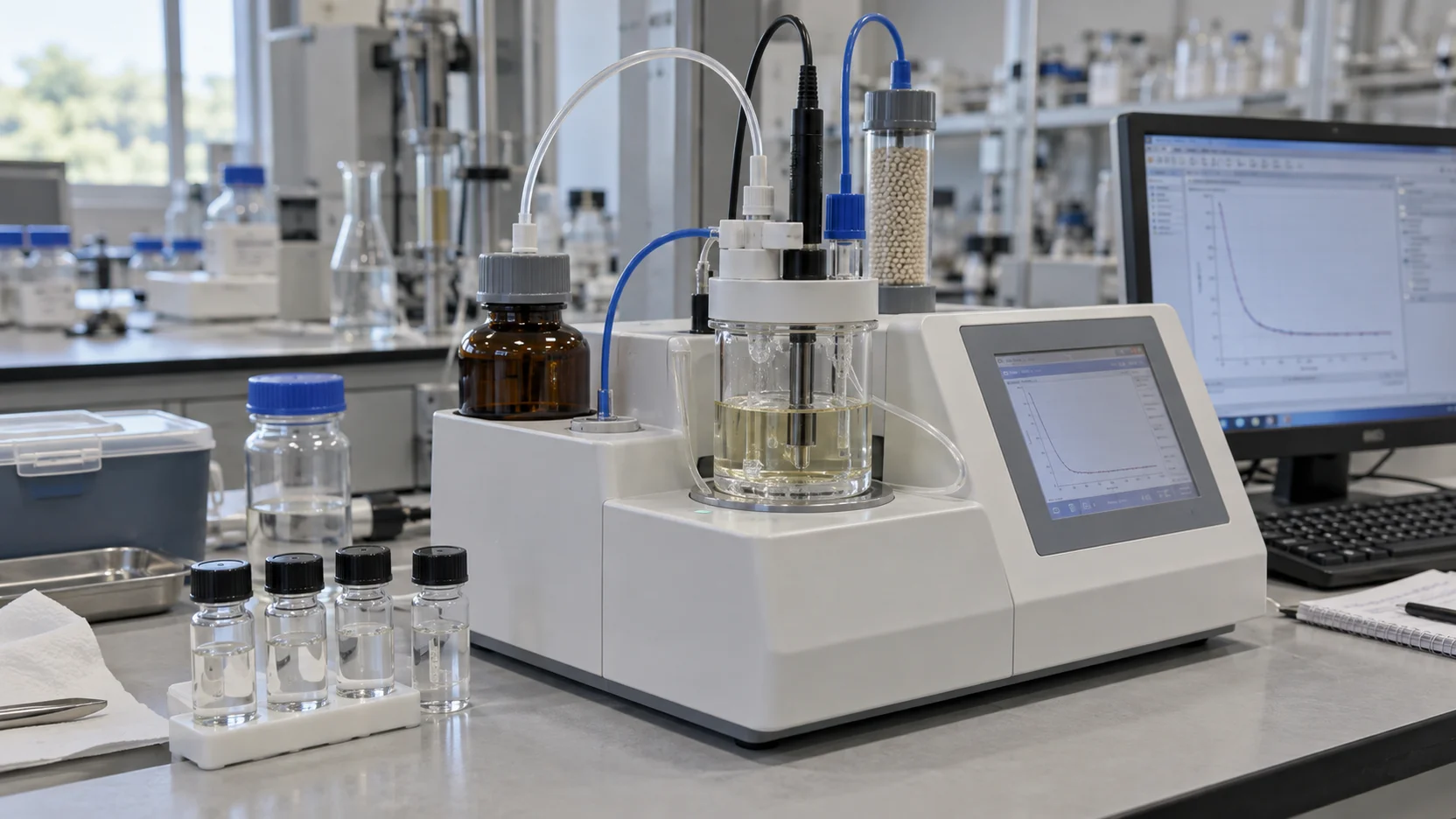
Water requirements for battery-grade carbonates should be defined in relation to applicable standards, product grades and application conditions. Specific limits need to meet the target electrolyte’s water-control requirements while accounting for raw-material quantities and water introduced by other components and handling. The solvent name alone is not enough to define these requirements.
How small is a concentration in ppm?
ppm means parts per million. For water expressed by mass, 1 ppm equals 1 milligram of water per kilogram of sample. Although small, this amount may still affect a water-sensitive reaction system. It does not imply visible water droplets: appearance generally cannot reveal trace water dissolved in a solvent.
Water results need a measurement basis. Mass ppm and volume ppm cannot be mixed directly. The ≤ sign in a specification defines the permitted upper limit; a value in a test report describes the tested sample. They serve different purposes.
Why small amounts of water can affect electrolytes
Lithium hexafluorophosphate (LiPF6) is a common electrolyte lithium salt. In LiPF6-containing carbonate systems, water can participate in associated decomposition reactions, generating acidic species including hydrogen fluoride. This may affect electrode interfaces, material corrosion, gas evolution and storage stability.
The extent depends on salt identity, temperature, additives and material surfaces. The same water value need not produce the same outcome in different systems. Water and acidity are also different parameters: after water reacts, measured water may fall while the byproducts already formed remain.
How limits relate to material quantities and processing
Water in an electrolyte does not come from only one solvent. Other solvents, lithium salts, additives, equipment and the operating environment may all contribute. On a consistent mass basis, multiplying each raw material’s mass fraction by its water content estimates its contribution before mixing. This is only a material balance and excludes subsequent moisture uptake or reaction consumption.
A raw material used in large quantities can therefore contribute considerable water even at a modest water content. A small additive dose may contribute less, but its reactivity with water still matters. Individual specifications should serve overall system stability rather than mechanically assigning the same upper limit to all five solvents.
Hypothetical example solely to explain a mass balance: assume A, B and C make up 60%, 30% and 10% of the final total mass and contain 10, 20 and 50 mg/kg water respectively. These letters do not represent specific solvents or an electrolyte formulation. The values are neither Lixing specifications nor a formulation recommendation.
| Hypothetical material | Mass fraction | Material water content | Water contribution to the total material |
|---|---|---|---|
| A | 60% | 10 mg/kg | 0.60 × 10 = 6 mg/kg |
| B | 30% | 20 mg/kg | 0.30 × 20 = 6 mg/kg |
| C | 10% | 50 mg/kg | 0.10 × 50 = 5 mg/kg |
| Total | 100% | — | 6 + 6 + 5 = 17 mg/kg (mass ppm) |
For 100 kg of total material, the three portions introduce 600, 600 and 500 mg of water, totaling 1700 mg. Dividing by 100 kg gives 17 mg/kg. A has half B’s water content but is used at twice the quantity, so their contributions are equal. This estimate excludes environmental moisture uptake, water introduced by equipment and reaction consumption, and therefore does not guarantee the measured value after mixing.
Water limits relate to application risks and the overall water-control objective. Sampling conditions, method suitability and measurement uncertainty affect how results are obtained and assessed. Both quality requirements and testing conditions need to be clearly defined.
Why measured values may differ
Karl Fischer analysis is commonly used to determine water through a quantitative reaction involving water. Method suitability, instrument background and sampling practices affect low-level measurements. Near a limit, measurement uncertainty also matters; the final digit cannot be treated as absolutely exact.
After open sampling or contact with damp utensils, a low-water sample may no longer represent the original state inside its packaging. Before interpreting differences between results, check whether they concern the same batch, comparable sampling conditions and suitable methods. Comparability matters more than additional decimal places.
Can water content change between release and use?
Yes. Factory sampling reflects the state after refining and filling at that time. Once the packaging is opened, humid air may introduce water. At use, residual water in transfer hoses or receiving containers may add further contributions. Comparisons need to account for these different material states.
Water requirements need both an application-appropriate limit and storage and handling conditions that preserve low water content. A lower number alone cannot replace these measures, and ordinary heating is not a universal dehydration method for restoring battery-grade quality.
In systems where water takes part in reactions, a lower final water reading may be accompanied by byproduct formation. Moisture protection during storage and handling therefore needs to remain effective, and water results should be assessed alongside related quality parameters.
References
Source scope: the 20 mg/kg value in Metrohm documentation is an example in its battery-material analysis context. It is neither a Lixing product specification nor a common limit for all five carbonates. The mass-balance table in this article uses separately identified hypothetical values.
Metrohm: water determination and analytical methods for battery materials
Agilent: GC/MSD analysis of carbonate solvents and additives in battery electrolyte (5991-9356EN)