
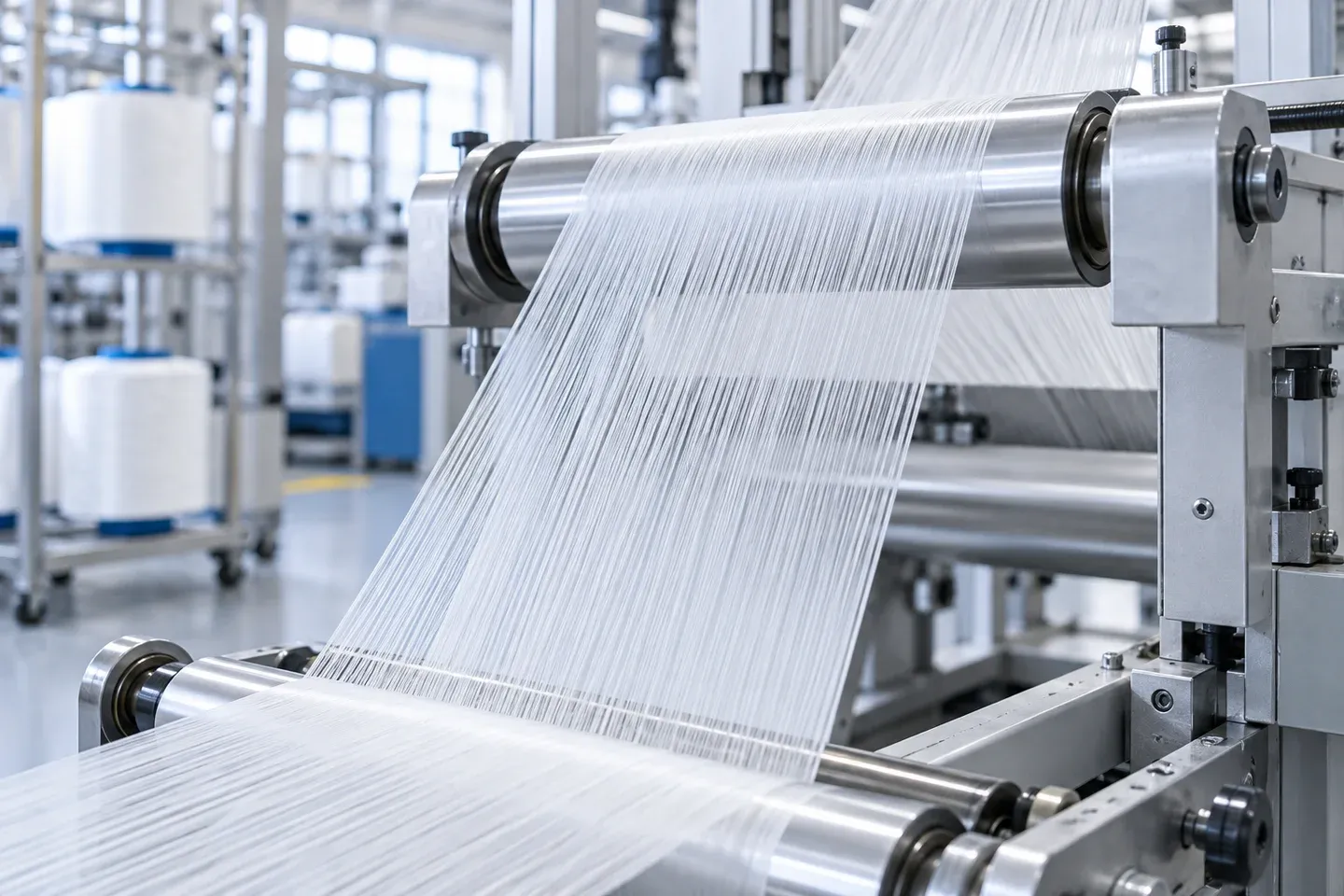
PAN-related materials illustrate two processing routes
Not all fibers are produced by solution spinning, and not every polymer becomes processable in the same carbonate. Materials related to polyacrylonitrile (PAN) provide a specific example: their processing requires coordination of polymer structure, flow and thermal stability. Published work on PC and EC includes both plasticized melt-spinning studies and wet-spinning patents. These routes must be understood separately.
A solution route first produces a polymer spinning dope, then forms fibers through solvent removal or solvent exchange. A plasticization route uses added components to reduce resistance to processing so that the polymer flows and takes shape within a suitable temperature range. Both routes may mention solvents and washing, but their starting states and control stages differ. Those shared terms do not make a melt-spinning paper a wet-spinning study.
PC as an external plasticizer for a copolymer
König and colleagues’ 2020 paper studied melt spinning of a PC-plasticized poly(acrylonitrile-co-methyl acrylate) copolymer. The methyl acrylate comonomer units modify the polymer structure, while PC is an externally added plasticizer. Together, these effects create the processing window studied. The material’s identity matters: these results do not automatically mean that every pure PAN can dissolve directly in PC at room temperature.
Plasticization can be understood in terms of polymer segment motion. To pass through spinneret holes, the polymer must flow within the processing time while maintaining sufficient continuity. Better flow aids shaping, but a material that relaxes too readily or cannot retain its subsequent structure still fails to meet fiber requirements. Changes in copolymer composition and molecular weight also alter the balance between flow, shaping and final strength.
The study examines rheology, spinning and washed fibers, providing an evidence chain linking material composition, processing and structure. It does not require readers to reproduce its temperatures and addition ratios. For another grade, the key question is whether polymer composition, molecular weight distribution and thermal history still permit shaping within a stable temperature range, rather than simply comparing the purchased material’s PC designation.
Technical references: [1]
Two routes with different concerns after shaping
Papers describe research systems and patents describe technical proposals. Neither establishes universal processing conditions for all fibers or every material grade.
What structure remains after PC removal?
The paper’s washing comparison provides a useful example. Batch-washed specimens held at fixed length developed pores, whereas specimens washed continuously with drawing developed denser cross-sections. Yet the mechanical results were similar for the two washing methods. The authors also observed loss of fiber integrity during plasticizer removal for certain copolymer compositions. These findings show why morphology and mechanical properties must be examined separately: fewer pores do not establish a proportional increase in every measure of strength.
From a mass-transfer perspective, washing liquid entering the fiber and PC migrating outward alter the internal composition, requiring polymer chains to reorganize. If structural rearrangement does not sufficiently fill the spaces left by departing liquid, pores may form. Drawing and washing conditions also affect that rearrangement. This explains the removal mechanism; specific outcomes still depend on the material and treatment path.
Spinnability and usability are therefore two connected assessments. Collecting a continuous fiber initially only establishes that it could be formed at that point. Whether it remains continuous after the plasticizer that needs removal has left, how its dimensions change, whether residual levels are appropriate and whether its strength suits the application determine the route’s practical value. Calling PC a processing aid does not mean it must remain permanently in the finished fiber.
Technical references: [1]
Water and EC in a different plasticization system
The abstract of Min and colleagues’ 1992 paper discusses PAN plasticization and fibers produced from plasticized melts. It reports synergistic plasticization by water and EC and compares the effect of water on melt viscosity. This result concerns a specific processing system and differs from treating water as a sensitive impurity in battery electrolytes.
The difference lies in water’s role. In that study, water is a participating component that affects polymer processability; in LiPF6-containing electrolytes, it may trigger unwanted chemical reactions. Quality requirements cannot be transferred between industries merely because both use EC. Nor does the plasticization study imply that water should be added to every spinning process. Unplanned variation in raw material moisture must also be distinguished from an intentionally specified water content in a formulation.
Technical references: [3]
Wet spinning centers on the dope and coagulation exchange
Historical patent US2967086 describes a wet-spinning route for PAN and related copolymers using solvents including EC and PC, linking coagulation with solvent recovery. The evidence is the route described in the patent. It establishes specific material and process proposals, not widespread current industry practice, and is not a Lixing production or customer case.
In a solution route, the spinning dope must first reach a state suitable for transport and shaping. Viscosity depends on polymer concentration, molecular weight and temperature. After initial uniformity is achieved, gel formation or precipitation during residence must still be considered. Filtration can intercept some particles and gels, but cannot make an inherently unstable solution permanently stable or replace an understanding of liquid-phase composition.
During coagulation, material exchange occurs between the fiber interior and the surrounding liquid, changing polymer concentration and phase state. Changes at the surface and inside the fiber need not occur simultaneously. Coagulation-bath composition, exchange rate and subsequent washing therefore jointly influence morphology. This explains why preparing a spinning dope is not sufficient; it does not derive on-site bath recipes or temperatures from a historical patent.
Technical references: [2]
Comparing outcomes from the two routes
Imagine two experiments that both produce continuous filaments: one by coagulating a uniform dope, the other by shaping a flowing PC-plasticized copolymer. Both may appear successful if only smooth passage through the spinneret is considered. Yet the first requires tracking coagulation exchange and solvent removal, while the second requires tracking whether the structure survives plasticizer removal. Residual levels and properties should be compared only with the treatment history of both types of sample clearly established.
Similarly, recovered liquid cannot be treated as equivalent to fresh material simply because it still contains PC or EC. It may introduce water, low-molecular-weight components or other substances picked up through contact, changing the composition of the next dope or plasticized mixture. What matters is identifying actual composition changes and their effects on the target system, rather than labeling every trace constituent a harmful impurity in advance.
Both routes reveal the same processing issue: achieving a processable state is only the first step. Retaining the required morphology after leaving the processing medium matters just as much. Different fiber applications have different requirements for porosity, dimensions, mechanical properties and residual content, so assessment must be linked to the final objective.
PC and EC raw material documentation
Lixing supplies PC and EC raw materials. Supply can be discussed in relation to the specific polymer, the role of the raw material and existing specifications. Reagents, copolymers and treatment conditions in published papers belong to those studies. Suitability of an available grade must be assessed against raw material documentation and actual application results.
Raw material enquiries
- Fiber material or polymer type and processing stage
- Method of solvent removal or recovery in subsequent operations, if established
- Existing raw material specifications and trial quantity, if any
Common questions
Does filtering the dope eliminate subsequent gel problems?
Filtration removes material that can be intercepted at that time. Changes in composition or temperature during residence may still cause new precipitation and gels, so dope stability must also be understood.
Is clear recovered PC equivalent to fresh material?
Clarity does not establish identical water content or dissolved constituents. Recovered liquid must be assessed by its composition and its effect on the next processing cycle.
Technical references
- [1] König et al. (2020): melt spinning of a PC-plasticized PAN–methyl acrylate copolymer
- [2] Historical patent US2967086: wet-spinning route for PAN-containing fibers
- [3] Min et al. (1992): water/EC plasticization of PAN and fiber study (paper abstract)
These sources provide further explanations of application principles. Delivery requirements for Lixing raw materials are defined by the product specification agreed by both parties.