
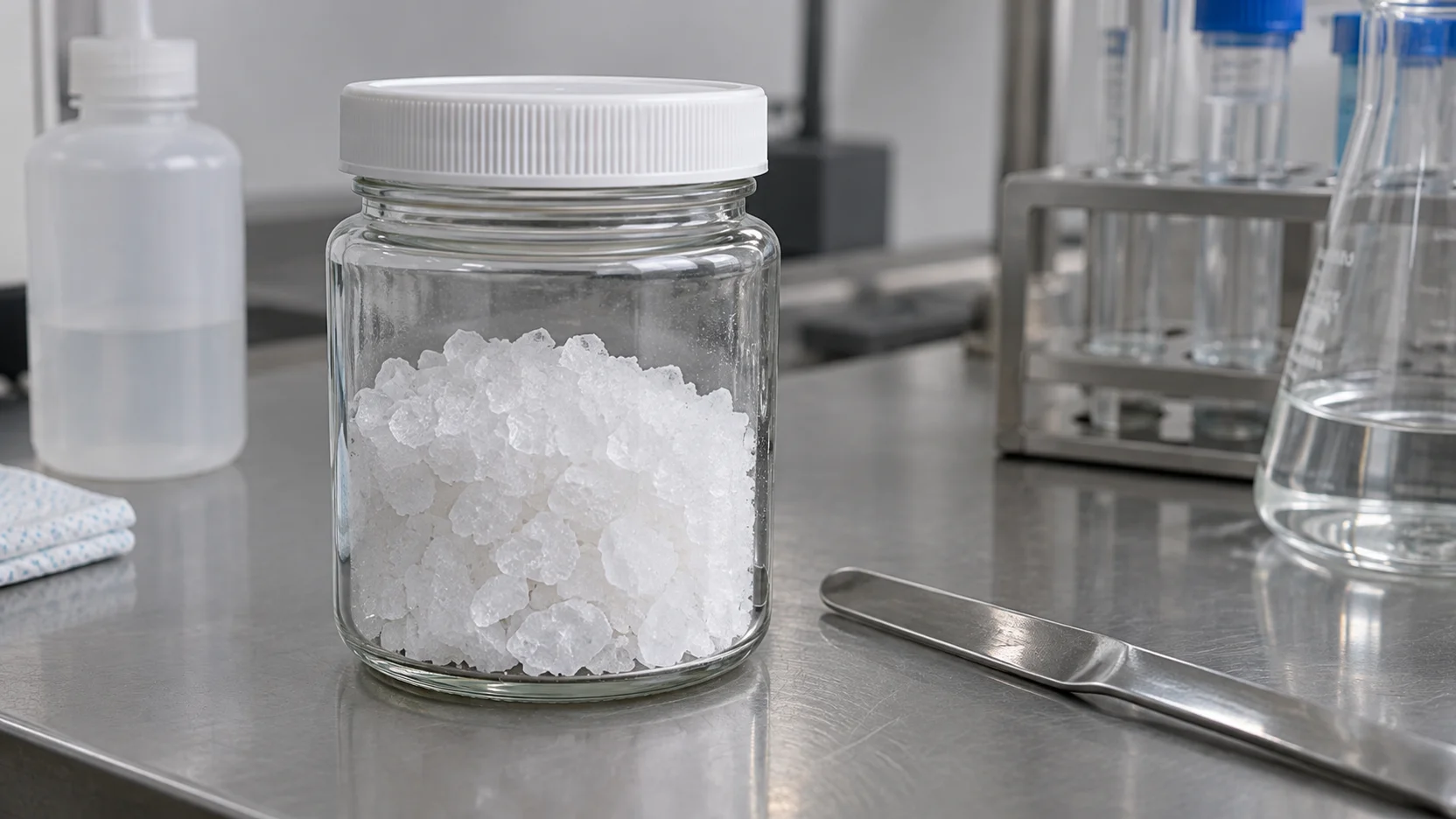
Ethylene carbonate (EC) may crystallize or be solid at ordinary room temperature because of its melting point. Crystallization itself does not mean degradation. Heating depends on the operation: storage need not always maintain a liquid state, while pumping and line transfer require suitable temperatures for liquid handling. One rule cannot cover both.
Why crystals appear at room temperature
Ethylene carbonate (EC) has a melting point above many ordinary room-temperature environments. Taking a pure-substance reference melting point of about 36°C, an ordinary environment around 20°C is below this temperature, so EC can crystallize and be solid. Solid and liquid may also coexist during melting or freezing.
Phase state can also lag behind temperature changes. A liquid may supercool: its temperature is below the equilibrium freezing temperature, but crystallization has not yet occurred. Temperatures inside large packages may also be nonuniform. Seeing liquid therefore does not establish a uniform temperature throughout the batch.
Does crystallization mean poorer quality?
A simple solid–liquid transition is a physical change. Crystallization alone does not establish chemical degradation. Quality assessment still needs to consider abnormal appearance and test results for water and relevant impurities.
When material is partly crystallized, sampling only a local liquid portion may be unrepresentative. Controlled melting and homogenization can improve phase uniformity, after which sampling should follow the applicable method. This process does not automatically remove water or other contamination already introduced.
Why storage and liquid transfer have different requirements
If the packaging allows solid storage and appropriate subsequent handling is available, continuous heating during storage is not necessarily required. Maintaining heat increases energy use and thermal exposure. It should follow product requirements and the use schedule, rather than being continuous simply because EC crystallizes.
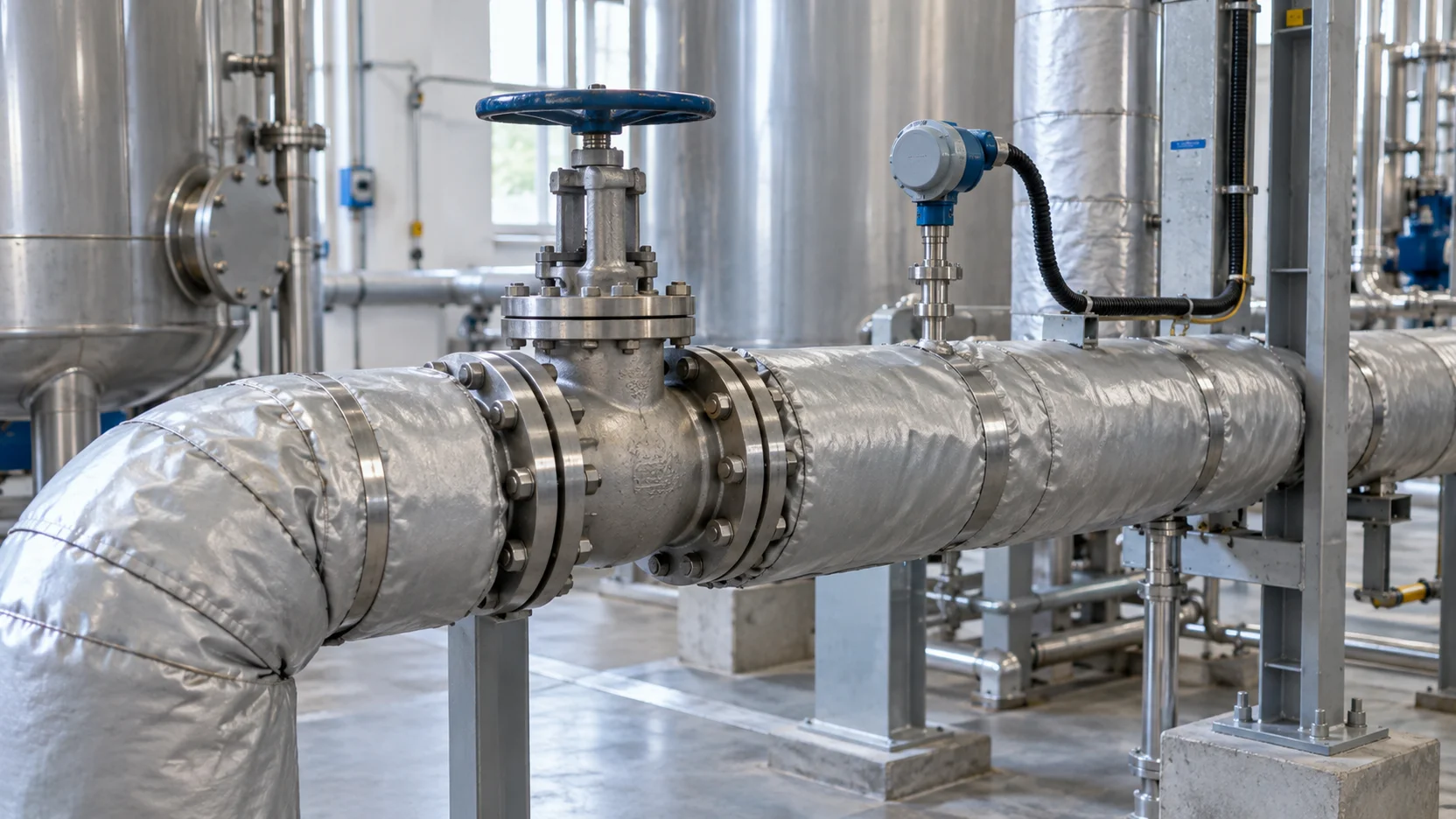
Pumping or liquid metering requires material in a suitable state for transfer and prevention of crystallization blockages at cold spots in lines, valves and filters. Flow in the tank does not establish that the entire line is suitable for transfer.
Why melting point is not a heating setpoint
Melting point describes a solid–liquid phase transition. Actual heating conditions also depend on packaging temperature limits, heating-surface temperature, heat-transfer rate and equipment capability. Large packages melt more slowly internally, and indiscriminately raising the external temperature may cause local overheating. Temperature, duration and pressure requirements should be determined for the specific material, packaging and equipment.
Heating methods must suit the product, packaging and equipment and include temperature monitoring and necessary protection. Open flames and uncontrolled high temperatures are prohibited. Thermal expansion and pressure changes also require consideration. Ordinary non-pressure-rated packaging must not be improvised for pressurization, and safety pressure-relief paths must not be blocked to retain heat or exclude moisture.
If a line is blocked, do not force material through by indiscriminately increasing pressure. Establish the blockage location, local temperature and equipment limits first, then follow the approved site procedure.
For example, when a container is heated externally, EC near the wall may melt while the center remains solid. The outer liquid temperature does not represent the center. Raising the external temperature further may widen that difference. Melting also requires the heat of phase change, so time, heat distribution and material uniformity jointly determine progress. One measurement point above the melting point is insufficient.
Moisture protection is still needed during heating
During melting, open inspection or transfer, humid air, utensils and gases may introduce water. Controlled heating should be combined with closed, dry handling. If nitrogen is used, ventilation, oxygen-deficiency and equipment-pressure risks must also be addressed.
During storage, check that packaging and environmental conditions can preserve material quality. Sampling and transfer also require confirmation of phase state, uniformity and equipment conditions. Retain batch information if an abnormality is found and assess it under the applicable procedure.
References
Physical-property source note: the approximately 36°C value used here is the melting point in the ‘Properties (reference)’ field on TCI’s E0076 page. The 37–39°C range under ‘Specifications’ on the same page is that reagent’s melting-point specification. These fields have different meanings. Neither is a Lixing delivery specification or a heating setpoint for industrial packaging; third-party reagent storage requirements also do not apply directly to industrial packaging.